

- Amusement
- Anywhere
Kefira Market
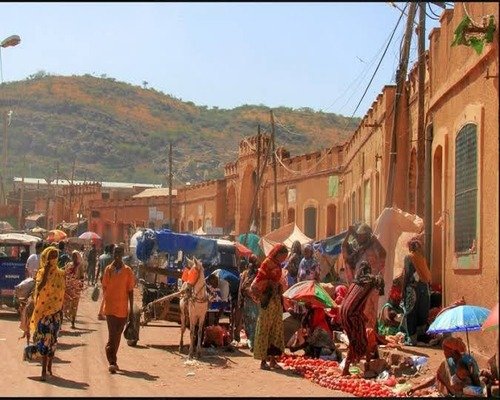
Where is Kefira Market?
Kefira Market is located in Dire Dawa City Administration, eastern Ethiopia, within the Kefira neighborhood, one of the city’s oldest and most densely populated areas.
The market sits near the historic urban core of Dire Dawa, not far from:
-
The old railway neighborhoods
-
Major road junctions linking the city center
-
Residential quarters that grew during the early railway era
Dire Dawa lies at the foothills of the eastern Ethiopian highlands, functioning historically as a trade gateway between the highlands and the Somali lowlands, and Kefira Market developed at the heart of this exchange.
-
Location: Kefira area, Dire Dawa City Administration
-
Elevation of Dire Dawa: ~1,200 m above sea level
-
Climate: Semi-arid lowland climate
How to Get There
Reaching Dire Dawa
-
By road: Addis Ababa – Harar – Dire Dawa highway
-
By air: Dire Dawa International Airport (domestic flights from Addis Ababa)
-
By rail: Modern Addis Ababa–Djibouti railway (station outside historic center)
Reaching Kefira Market
-
Kefira Market is easily accessible from most parts of the city:
-
Taxi or bajaj (three-wheel taxis)
-
Short walks from nearby neighborhoods
-
-
The market is well known locally — asking for “Kefira” is enough.
There are no fixed entry points or visitor centers; the market blends directly into the surrounding streets.
Things or Places of Interest at Kefira Market
A Major Urban Marketplace
Kefira Market is one of Dire Dawa’s largest and most important markets, serving thousands of people daily.
Goods commonly sold include:
-
Fresh fruits and vegetables from surrounding highlands and lowlands
-
Grains, pulses, spices, and cooking ingredients
-
Meat, fish, and dairy products
-
Clothing, shoes, and household goods
-
Electronics, tools, and spare parts
-
Khat, a major regional cash crop
The market operates as both a retail and wholesale hub, linking rural producers with urban consumers.
Informal and Formal Trade Side by Side
Kefira Market is not a single building — it’s a living system.
You’ll see:
-
Permanent shops and stalls
-
Temporary street vendors
-
Traders spreading goods on cloths along the roadside
-
Porters carrying goods through crowded alleys
This mix reflects Ethiopia’s broader economy, where informal trade plays a crucial role in everyday survival.
Sensory Experience
Walking through Kefira Market is intense and immersive:
-
Calls of vendors advertising prices
-
Smell of spices, coffee, and cooked food
-
Sounds of bargaining in multiple languages
-
Dense movement of people, carts, and animals
This is not curated tourism — it’s full-scale urban life in motion.
Culture and Social Life at Kefira Market
A Crossroads of Communities
Kefira Market reflects Dire Dawa’s deep diversity.
Communities active in and around the market include:
-
Oromo
-
Somali
-
Amhara
-
Harari
-
Gurage and others
Languages commonly heard:
-
Afan Oromo
-
Somali
-
Amharic
-
Arabic (in trade contexts)
The market functions as a neutral meeting ground, where ethnic and cultural boundaries soften through daily economic interaction.
Gender and Livelihood
Women play a central role in Kefira Market:
-
Selling vegetables, spices, cooked food
-
Managing small retail stalls
-
Supporting household incomes
For many families, market trade is not optional — it is the primary means of survival.
Economic Importance of Kefira Market
Urban–Rural Link
Kefira Market connects:
-
Highland farmers (vegetables, grains)
-
Lowland pastoralists (livestock products)
-
Urban consumers and traders
Produce arrives from areas such as:
-
East Hararghe highlands
-
Surrounding lowland zones
-
Rural kebeles around Dire Dawa
Without markets like Kefira, Dire Dawa’s food system would not function.
Employment and Informal Economy
The market supports:
-
Traders
-
Porters
-
Transport workers
-
Food vendors
-
Small-scale processors
Many people working here have no alternative employment, making the market socially critical as well as economically vital.
History of Kefira Market
Origins in the Railway Era
Kefira Market developed alongside the growth of Dire Dawa in the early 20th century, after the arrival of the Ethio–Djibouti Railway in 1902.
As workers, traders, and migrants settled near the railway:
-
Demand for food and goods increased
-
Informal trading zones formed
-
These zones gradually solidified into permanent markets
Kefira emerged as one of the city’s key commercial areas.
Survival Through Change
Over decades, Kefira Market has endured:
-
Colonial occupation
-
Political transitions
-
Economic reforms
-
Rapid urban population growth
While buildings and stalls change, the market’s function remains constant: supplying the city and sustaining livelihoods.
Challenges and Modern Realities
Kefira Market also reflects urban pressures:
-
Overcrowding
-
Sanitation and waste management issues
-
Limited infrastructure for traders
-
Tension between formal regulation and informal livelihoods
Attempts to “modernize” markets sometimes fail because they underestimate one truth:
👉 You can’t replace a social system with concrete alone.
Why Visit Kefira Market?
You don’t visit Kefira Market for comfort or quiet.
You visit it to:
-
Understand how Dire Dawa really works
-
See economic life without filters
-
Observe cooperation across cultures
-
Witness resilience in everyday form
If Gorro Gutu Mountain tells the story of land and rural identity,
Kefira Market tells the story of urban survival, exchange, and coexistence.
It is not polished — and that’s exactly why it matters.
Explore

Hotels

Restaurants
Tourist Sites